
Where MCI-H Releases Go
Maryland Correctional Institution-Hagerstown holds sentenced adults within the Maryland Department of Public Safety and Correctional Services system. A person may leave MCI-H for another Maryland prison, a community placement, discretionary parole, statutory conditional release after diminution credits, sentence expiration, a court order, or exceptional medical parole. Diminution credits are sentence credits that can advance a conditional release date under Maryland law. A move to another institution is not a discharge, even though MCI-H no longer houses the person.
The executed DPSCS movement or release record is the clearest source because it identifies both the end of MCI-H custody and the next status. VINE can add a custody-change event. The sentencing docket may show a court order or sentence terms, while the Maryland Parole Commission can hold the public portion of a parole action. If the person entered community supervision, the Division of Parole and Probation is the responsible supervision agency. Each source answers a narrower question, so no single missing locator result should be stretched into a claim of community release.
Confirm an MCI-H Release
Begin with the DPSCS Incarcerated Individual Locator. It accepts first and last name and identifies covered people who are currently housed in a state correctional facility. DPSCS warns that people no longer in custody for any reason, including release or escape, are removed. The tool does not provide a lasting released or discharged profile, historical release date, supervision field, or public projected release date. A match can establish present covered custody. A no-result cannot establish why custody is absent.
Follow a no-result or changed institution through a state-specific confirmation chain:
- Try reasonable forms of the person’s first and last name in the DPSCS locator and record the date checked.
- Search Maryland VINE by name or identification number, then compare the reporting institution and custody event.
- Read the sentencing case for sentence, release, modification, or court-directed events. Request the actual order if exact wording matters.
- Request existing release or movement fields from DPSCS or MCI-H. Ask for the date, type, and destination if releasable.
- Where parole or conditional-release supervision applies, contact MPC or DPP for the lawful verification route.
Maryland offers no public statewide person-by-person parole or probation lookup. The Maryland Parole Commission also does not publish a general decisions database. The MCI-H record path must therefore rely on the specific public portions available from the agencies, not an assumed online profile. General county search paths are compared on the Washington County released inmates page.
Note: A current DPSCS locator disappearance is a clue only and cannot distinguish release, transfer outside coverage, escape, or a data issue.
MCI-H Release Records Contact
MCI-H can route inquiries about its own institutional records, while DPSCS handles the state public-record process. A former prisoner requesting a personal base or medical file is directed by DPSCS to the releasing institution or the Case Management Office for Operations. A purpose-neutral request for another person should be narrow. Ask for an executed release date and type, movement destination if releasable, and the specific admission tied to the known name and state identifier. Do not ask the custodian to create a history or calculate a date not already in a record.
Maryland Correctional Institution-Hagerstown
18601 Roxbury Road
Hagerstown, MD 21746
240-420-1000
Use the DPSCS Public Information Act process for state records. DPSCS asks requesters to state the maximum fee they are willing to pay and permits requests for an estimate. The first two search and preparation hours are free under the stated policy, though later work can carry reasonable costs. Correctional Services §3-602 protects the contents of a DOC case record except for listed access routes and safeguards. That rule may limit a whole-file request. A focused request for releasable terminal fields gives the custodian a clearer record to review.
MCI-H Release Record Types
State-prison terms describe different stages. Parole is a discretionary community release ordered through the Maryland parole process before sentence expiration. Conditional or mandatory release can follow the operation of sentence credits under statute. Discharge or expiration means the sentence reached its lawful end, subject to the actual record. A transfer only changes the place of confinement. A parole hearing date, eligibility date, recommendation, and executed release date are not interchangeable.
- Transfer
- Movement from MCI-H to another custodial location, not release to the community.
- Parole
- Conditional community release approved through the Maryland Parole Commission process.
- Conditional release
- Release before maximum expiration under the applicable sentence-credit framework, with legal conditions.
- Discharge
- The recorded end of the sentence or correctional obligation identified by the agency.
A useful MCI-H record identifies the individual, state identifier, institution, admission or sentence context, movement date, movement type, releasing authority, and destination where disclosure is permitted. Pairing those fields prevents a transfer from being misread as discharge. VINE and DPP may then explain whether a later custody or supervision status exists, but their information must be matched to the same person and event.
Release dates also need exact labels. An eligibility date means the person may be considered under the governing rules. A date on an open-parole-hearing list means a hearing is scheduled. A maximum date, a credit-adjusted estimate, and a signed parole action each describe different points in the sentence process. None proves the person passed through MCI-H’s release process on that date. Ask for the executed institutional entry when the question is historical, then use the other dates only to explain how the recorded outcome developed.
MCI-H Release Facility History
Maryland Correctional Institution-Hagerstown opened in 1932 according to its official DPSCS facility page. It is a medium-security Maryland state prison. That long state role differs from Washington County Detention Center, which is the local county jail. The WCSO roster cannot search MCI-H admissions or departures, and WCSO is not the custodian of MCI-H discharge records.
The official MCI-H page identifies the institution and its DPSCS place in the Hagerstown prison complex.
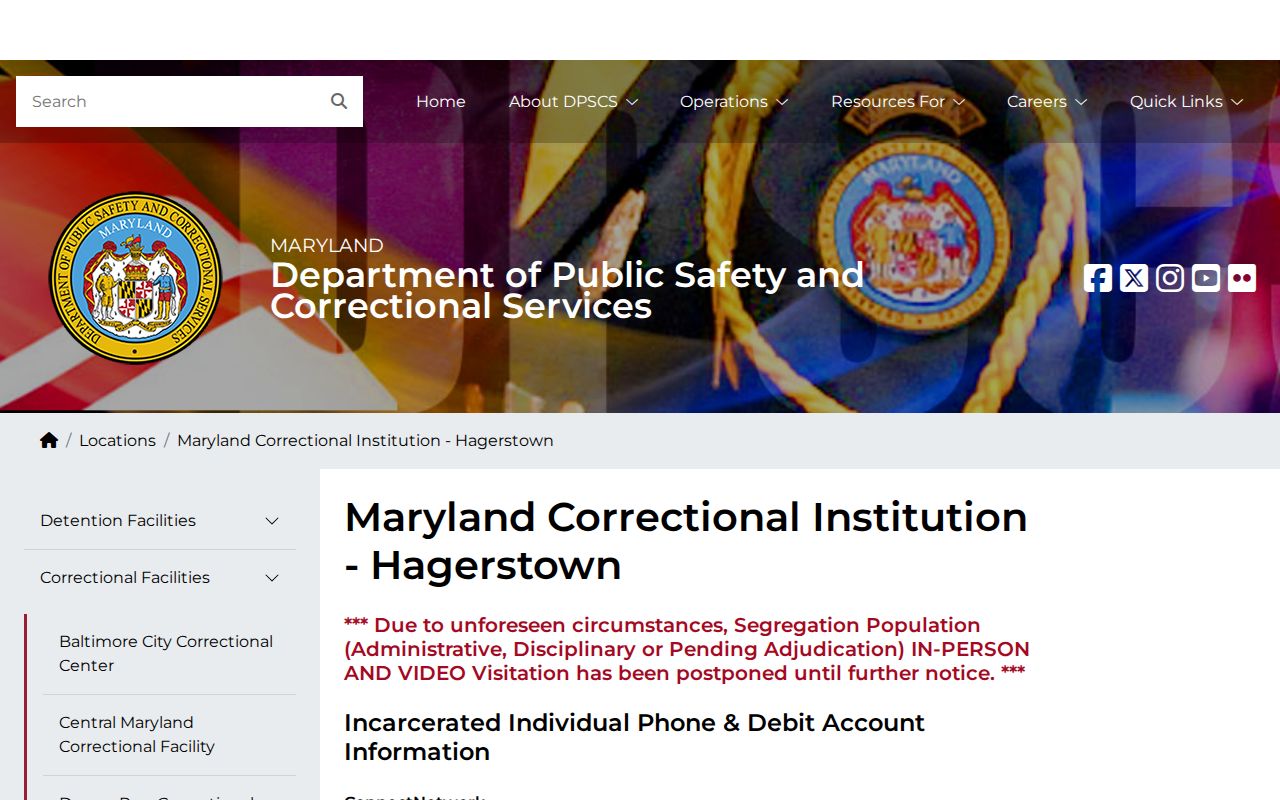
The captured facility page helps verify the prison identity and contact, while release history must still come from DPSCS records and the related state or court channels.
Washington County contains three adult DPSCS institutions in addition to its county jail. MCI-H and Roxbury Correctional Institution are medium-security prisons, while Maryland Correctional Training Center includes medium, minimum, and prerelease levels. That concentration makes the source label vital. “Released in Washington County” could refer to a local jail event or a state-prison discharge, and those statements require different records.
MCI-H Release Supervision Check
A person released from MCI-H may enter parole, mandatory or conditional-release supervision, or reach a sentence end without that same supervision path. The Maryland Parole Commission decides parole suitability and maintains the official parole process. The Division of Parole and Probation administers supervision. Case Search may show probation imposed by a court, but probation is a court-ordered alternative or condition and is not the same as parole from a prison sentence.
| Question | Responsible route |
|---|---|
| Is the person currently in a covered state prison? | DPSCS Incarcerated Individual Locator |
| What movement ended MCI-H placement? | MCI-H or DPSCS executed movement/release record |
| Was parole granted? | Public portion of the MPC action, not merely a hearing calendar |
| Is community supervision involved? | DPP lawful verification route and relevant court or release record |
The DPP Hagerstown Field Office is at 100 West Franklin Street in Hagerstown and lists 240-420-5140 and 240-420-5150. Staff can explain the lawful route for supervision questions but may not disclose protected details to every caller. The Washington County post-release supervision page distinguishes parole, probation, conditional release, and discharge.
Open MPC hearings add another limited source. The current master list is year-specific, and only hearings that meet the applicable public-hearing rules appear. Public meetings and meeting minutes are not a person-by-person results search. When a hearing appears, it establishes only that a proceeding was scheduled under those rules. Request the public decision or vote from MPC and compare it with the DPSCS release entry before stating that parole took effect.
MCI-H Release and ICE Status
A detainer is a request or legal basis for another agency to take custody when the current confinement ends. If an MCI-H movement record reflects an immigration transfer, release from DPSCS does not mean release to the community. ICE’s Online Detainee Locator checks current ICE custody. It does not provide a historical release index, and a no-result can arise from exact-match issues, lag, transfer, a person outside the system’s scope, removal, or release. The DPSCS movement record and the responsible federal agency must be reconciled.
The proposed ICE processing facility near Hagerstown is non-operational on the dated research record. Washington County described it on March 18, 2026 as a proposed short-stay intake location, with typical stays of three to seven days before out-of-state transfer. The Maryland Attorney General reported on April 15, 2026 that a preliminary injunction halted construction and operation. That posture must be checked again before publication. It is local facility history, not a place to search for someone released from MCI-H.